“Dare To Know” is the English translation of the Latin saying “SAPERE AUDE” that Emannuel Kant used in his essay “Answering Question: What is Enlightenment.” Dare to know can be “translated” as dare to go beyond and against stereotypes that are insidiously imposed, be ready for surprises, and be observant with a free mind, as nothing is as it looks first. So many of us are “fast and furious” to support the first available, cunningly promoted narrative without questioning. Usually, that first narrative suits our view, and few are ready to question it. So DARE TO KNOW! To dare is to start reading! To dare is to have a habit of reading books. Especially those books that are being put aside, by the order of conspiracy practitioners, to collect dust. And some of those are in front of us, but we prefer to believe narratives and nice, sweetened, artificial information we get instantly! To know takes time, and to dare to know means that patience and consistency in searching are crucial.
Some years ago, I had a conversation with a kind and deeply informed man, a professor, an esoteric, and a brother of a well-known so-called conceptual artist, who is well-positioned in the circles described in the legendary Stanley Kubrick movie “Eyes Wide Shut.”
He then said that the plan of the deepest forms of power ( he did not mention government) is to divide America into twelve parts! Then, as well as now, this could sound like science fiction. Or maybe for some, having in mind the state of the events that are unravelling in front of us, this “science fiction” is becoming reality. By the way, he predicted Mr. D.J. Trump’s win long before it was obvious that he would win a second term.
He supported the claim by mentioning that the Federal Reserve has formed Federal Reserve Banks in 12 districts.
District 1: Boston
District 2: New York
District 3: Philadelphia
District 4: Cleveland
District 5: Richmond
District 6: Atlanta
District 7: Chicago
District 8: St. Louis
District 9: Minneapolis
District 10: Kansas City
District 11: Dallas
District 12: San Francisco
That division looks like this…
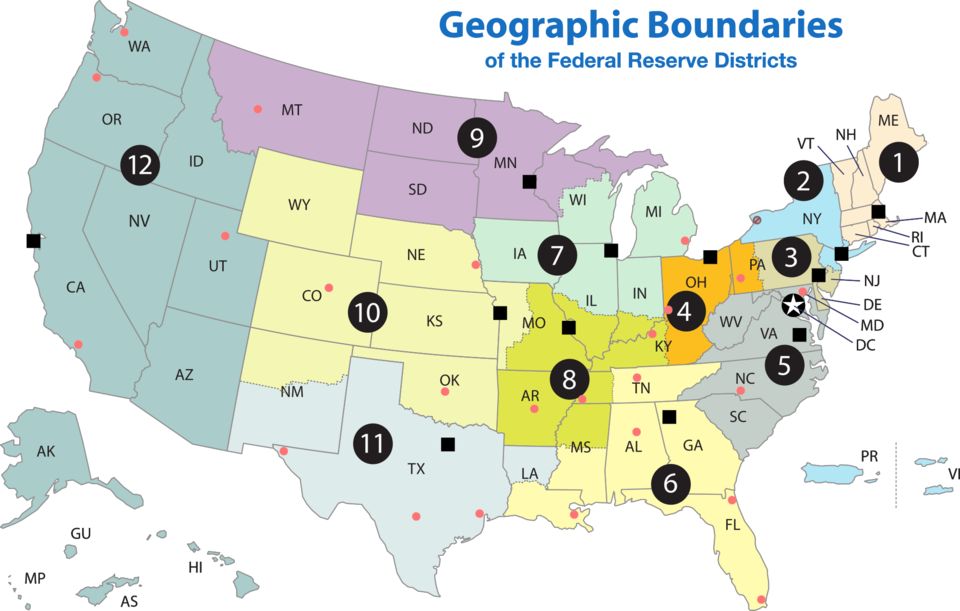
“Geographic boundaries…” The stage is set, probably awaiting the right time.
Then, while talking with the professor, I remembered that some two decades or more ago, I came across the proposal to introduce a second USD, $. Another science fiction… So, to have two different $. The proposal leading to that was signed by many prominent personalities at the time. I remember two. Strobe Talbott and Madeleine Albright. The logic behind this was to keep one $ to be used only in foreign transactions and thus apart from other important factors, to be secured and protected in value with fixed interest rates, to allow the issuance of government bonds to US creditors, and the other $ to be used only in domestic transactions within the USA. That second $ would be subject to free fluctuations and would be devalued.
This brings us to the second D.J.T term.
Why has D.J.T. been chosen, then presented, and then elected?
Why was General Flynn forced to resign? Why was Steve Bannon left aside? The answers to these two questions will bring us very near the truth in this case. There are two opposing forces in the US. One of the status quo that wants to live as it lives today, plus to rob as much as possible around to pay for their debts, and the other, which sees that America as it is today becomes unsustainable, exactly as the Soviet Union at the time of its dissolution. In his recent book ” La Defaite De L’Occident” or in English “The Defeat of the West,” Emanuel Todd presented his findings, statistically, so I will not bother you with it. You can see with your own eyes if you live in the Western hemisphere. Especially the USA. By the way, I am proud that I got Emanuel’s book translated into English, and I offered it to all of the DUSTY BOOK CLUB members.
Another rumor that is being shily but steadily promoted is the discord of the USA’s top military brass with the policies of the current president. This president has been elected with the promise that there would be no new wars, no more regime changes, and that America would be Great Again. After some months, we learned that none of those promises were kept, and people started to “meet” a different person from the one they voted for. We are seeing a person who is imagining that he is an emperor. If we analyse what kind of power he has and if he can use it, one is certain. He has a tremendous power, and yes, he can use it.
That brought another thought back to mind. Namely, in his book “The Coming Caesars,” published in 1957, Amaury de Riencourt anticipated the appearance of the new Ceaser. Not in Europe but in America.
Let me share some of his analyses and predictions. Then you might call him a PROPHET.
I will start with President Wilson, whom I mentioned in my first long essay, Conspiracy Practitioners, now available for my subscribers.
Below, the author mentions President Wilson, who won his reelection, declaring that the USA would stay out of World War I. He omitted to mention Colonel Edward House, the “grey eminence” who found and promoted Woodrow Wilson from the Governor of New Jersey to the President of the USA. Not to mention that he was the power, the hidden hand, behind the Federal Reserve Act, America’s entering WWI, the Council of Foreign Affairs, and what few people know, the man who cunningly helped Harry Truman to become the Vice President instead of Henry Wallace… Result, you know. Also he could be called the “father” of the team around Dulles brothers and others that became a deep state of the USA…
Here are some of Amaury de Riencourt’s thoughts.
“AMERICA became fully conscious of her individuality during World War I. Until then, her history had merely been a chapter in the history of European expansion throughout the world. It took the momentous shock of a global war to start an entirely new phase of America’s evolution, to emancipate her from European tutelage and to make her conscious of being something different and apart from the rest of the Western world—no longer a marginal society but a dominant factor in world politics and economics. Then, she truly became the New Rome as opposed to “Hellenistic” Europe. This metamorphosis was intimately involved with the end of the frontier, of large-scale immigration, and of the self-reliant individualism that had been a marked feature of her personality in the nineteenth century. It was a change of historical phase, the beginning of an autonomous Civilization in its own right, of a society that was becoming increasingly cohesive, whose standard of living was fast increasing while Europe’s was stagnating or declining. It was the new age of mass production in which America excelled above all others, the age of what the admiring Germans called Fordismus. Woodrow Wilson was at the helm when America entered the stormy waters of the World War. He had already proved to be a strong President so that there was no vacillation in executive authority, no Congressional government. America remained neutral for a time but many of her outstanding leaders saw clearly what was at stake—a struggle to the finish between the Germanic Central Powers and the English-speaking nations for leadership of the Western world. Many farsighted Americans felt that a German victory would deal a fatal blow to democracy as they conceived of it, besides forcing America to build a large military machine against her own profound inclinations. The safety of the Atlantic Ocean required that America help preserve the independence of the old European nations on the opposite seaboard, a necessity that had been foreseen as early as the 1890s by men like Henry Adams and John Jay. Geopolitical facts were compelling. America could never remain neutral in a contest in which she was as basically involved as France and Britain. The tragedy was that Wilson’s leadership proved inadequate throughout the entire conflict. Instead of dominating the field and laying down a long-range policy, he let himself be swayed by the strong isolationist sentiments that prevailed in the Middle West, asking in his Proclamation of August 1914 for complete neutrality in thought as well as in deed. Later on, when compelled to switch to a war policy, he had to reverse himself completely—not only in action but, what was far more calamitous, on the ideological plane as well, and present the inevitable participation of America in the conflict in such emotionally charged terms that he became the prisoner of irrational forces which he no longer controlled. Worse still, Wilson failed to rise to the required status of a national leader, failed to emancipate himself from party politics, and remained confined within the narrow bounds of his Democratic party. Failure to draw to himself the best among the Republicans and develop a bipartisan leadership paid sour dividends after the war. Unwittingly, he himself injected party politics into the peace talks and dragged global policy down to the level of American internal political squabbles. He had failed to become the true tribune of the whole nation that circumstances required. Public opinion had completely rallied behind him during the hostilities and he had received bipartisan support. Yet he rejected the Republican overtures and appealed to the voters in 1918 to return a Democratic majority, the greatest blunder he could have made. The American people, emotionally shaken by the war, wanted a national leader, not a party chieftain who would make Democratic capital out of a national victory. Wilson behaved like a party politician and yet talked to the world like an inspired prophet. His Messianic speeches antagonized most Congressional leaders and tragically misled the Europeans who expected to see his policy backed by Congress, as it was in fact by American public opinion. He was a prophet but not a statesman and his unrealistic idealism made him an inept politician. This catastrophic failure did not prevent him from behaving all through the war like a Roman constitutional dictator, taking the full “war powers” as they had already been developed by Abraham Lincoln, in addition to which he seized control of the nation’s economic sinews—so vastly increased since the Civil War—with full Congressional approval. He had in fact become “a combination of King, Prime Minister in control of legislation, Commander-in-Chief, party leader, economic dictator and Secretary of State for foreign affairs.”131 Vague attempts of Congress to recreate the “Congressional Committee on the conduct of the war” that had plagued Lincoln were firmly put down. Wilson even persuaded Congress to hand over to him all the powers that the lawmakers wanted to grant to an autonomous War Cabinet. Never had America seen such a concentration of power in the hands of one single man….”
He foresaw one new “Cesar” to appear in the future. Is that future now?
Here it is
“OUR Western world, America and Europe, is threatened with Caesarism on a scale unknown since the dawn of the Roman Empire. In order to see this threat in its proper perspective, we have to assess the relationship between America and Europe, and define their historical destinies. It is the contention of this book that expanding democracy leads unintentionally to imperialism and that imperialism inevitably ends in destroying the republican institutions of earlier days; further, that the greater the social equality, the dimmer the prospects of liberty, and that as society becomes more equalitarian, it tends increasingly to concentrate absolute power in the hands of one single man. Caesarism is not dictatorship, not the result of one man’s overriding ambition, not a brutal seizure of power through revolution. It is not based on a specific doctrine or philosophy. It is essentially pragmatic and untheoretical. It is a slow, often centuries-old, unconscious development that ends in a voluntary surrender of a free people escaping from freedom to one autocratic master. New concentrations of power during the past fifty years of world wars, revolutions, and crises, have made this threat of Caesarism increasingly evident. Political power in the Western world has become increasingly concentrated in the United States of America, and in the office of the President within America. The power and prestige of the President have grown with the growth of America and of democracy within America, with the multiplication of economic, political,and military emergencies, with the necessity of ruling what is virtually becoming an American empire—the universal state of a Western civilization at bay. Caesarism is therefore the logical outcome of a double current very much in evidence today: the growth of a world empire that cannot be ruled by republican institutions, and the gradual extension of mass democracy, which ends in the destruction of freedom and in the concentration of supreme power in the hands of one man. This is the ominous prospect facing the Western world in the second half of the twentieth century. But just as Caesarism could arise only in Classical Rome and not in Greece, it will, if left free to develop unchecked, arise in modern America and not in Europe. It is in Washington and not in London, Paris, or Berlin that the Caesars of the future will arise. It will not be the result of conspiracy, revolution, or personal ambition. It will be the end result of an instinctive evolution in which we are all taking part like somnambulists. The evidence is all around us today, but to see it in its full magnitude, we must step back into history and look at the present from a distance. We shall then have a clear perspective of the road on which we have been traveling for centuries—and a glimpse of the road that lies ahead. We shall then notice that, instead of forever inclining toward the republican left, we are in fact swinging toward the autocratic right and that it is our leftist leaders who, whenever they are in power, are unwittingly taking us in this direction. In fact, they have quite unconsciously been driving us around in a centuries-wide circle, back to the point from which our ancestors started when they revolted in the name of liberty against the tyranny of absolute monarchs. Familiarity breeds contempt, dulls perception and understanding. What is familiar has to become unfamiliar and strange before we can truly grasp its full meaning. We must see in the President of the United States not merely the Chief Executive of one of the Western democracies, but one already endowed with powers of truly Caesarian magnitude. Today, one man is directly in command, either as peacetime President or wartime Commander in Chief, of more than half the globe’s economic and technical power. Along the militarized borders of the Western world he is in full control, as Augustus and the Roman emperors after him were in full control of the limes. As an autonomous Executive who is constitutionally free from parliamentary interference, he is all at once Chief of State and head of government in control of all cabinet appointments as well as Commander in Chief of the most powerful armed forces in the world. He is the only statesman in the Western world who can make major decisions alone in an emergency. He is in control of a de facto empire into which the scattered fragments of the dissolving British Commonwealth are gradually being merged. Everywhere, on the European continent, in the Western Hemisphere, and in the Far East, he can make the weight of his incalculable power felt with immediate and crushing speed.”
He finishes the chapter with a warning…
“The growth and civilized greatness of Rome and America are no more accidental than the cultural endowments of Greeks and Europeans. In every developing Culture are the seeds of the oncoming Civilization that will eventually assume the burden of preserving the cultural heritage thus accumulated. Some chosen nations are the depositories of those seeds, and the worldwide responsibilities that fall upon their shoulders with startling suddenness have in fact been allocated to them centuries before by an inescapable destiny. However, the way they handle these crushing responsibilities is not predetermined. So far, all Civilizations have chosen the easy solution of Caesarism. But Caesarism itself, if allowed to develop unchecked, implies organic death for the society that gives itself up to it out of fear of freedom. And whereas in the past a new Culture has always sprung from the ruins of an antecedent Civilization and blossomed forth, the wreck of our own Western Civilization might well mean absolute death for the entire human race. What was only an episodic drama in the past might be final tragedy tomorrow. Modern man’s technological power will no longer allow him to make those grievous mistakes that past Civilizations were free to indulge in—nor can he ignore the lessons of a past that other Civilizations did not possess. Man’s technical knowledge makes it possible for him to build heaven on earth or destroy his planet, and his historical knowledge makes it possible, for the first time, to avoid those deadly shoals on which every other Civilization has destroyed itself.”
This work has been published in 1957.
We are now in 2026.
If you want to learn more about the plans and predictions of the hidden hands and their corrupted, I will call them slaves, please subscribe below. You will automatically become a member of our DUSTY BOOK CLUB and start receiving beautiful books that will change the way you see the world.
Darko Richard Lancelot
April 15, 2026
Philosophyofgoodnews
Connect and Respect