What’s a piece of media (book, movie, song) that changed how you see the world?
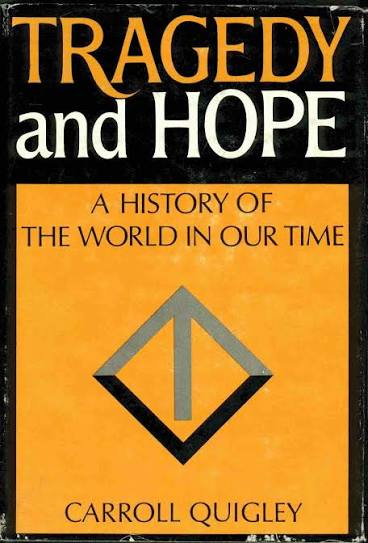
Tragedy and Hope: The Book That Opened a New Horizon
Carroll Quigley’s Tragedy and Hope is not simply a book. With its 1,311 pages, it is a work that helped structure my thoughts and introduced me to a different way of looking at the world. Not the superficial world we are told to accept, but the deeper world of power, finance, history and influence.
For anyone willing to read between the lines and connect the information presented, this book can feel like water in the middle of the desert.
I have written before about its author, Professor Carroll Quigley of Georgetown University. Returning to his work is always worthwhile, because Tragedy and Hope remains one of those rare books that rewards patience, attention and serious reflection.
One of the most striking stories connected to the book concerns a member of President Kennedy’s administration. According to accounts I have come across, he expressed surprise that the book had been allowed to be printed and distributed. In his view, the information contained in it revealed the aims, techniques and methods of powerful networks operating behind the scenes.
The explanation, perhaps, was simple. Quigley was a highly respected professor at Georgetown University. His credentials gave the book legitimacy. He had been allowed to study papers and materials connected to influential circles. But because the book was so long, dense and academic, very few people were likely to read all 1,311 pages carefully.
That may have been part of its strange protection. The crucial information was there, but hidden in plain sight.
Quigley’s work prepares the reader to look at history differently. It shows how power is organised, how financial structures shape political decisions, and how public understanding can be guided, limited or manipulated. Many other authors, including myself, have used his book as a starting point for further research.
One of the key turning points was December 1913, when the Federal Reserve Act passed through Congress and became law. From that moment, debt became increasingly central to the structure of modern political and economic life.
Debt was gradually introduced into the lives of nations and individuals. It became a mechanism of dependency. It changed the relationship between citizens, governments, banks and power.
And what is one of the most effective ways to create debt?
War.
The First World War was later remembered as the Great War. Great sacrifice brought great debt. Great debt brought greater control. Greater control brought greater profits for those positioned to benefit from it.
From the relative optimism and expansion of the late nineteenth century, the world entered a period of permanent pressure, turbulence and managed instability. Quigley explains the rise and decline of civilisations, the transformation of values, and the growing role of debt in shaping political and social life.
Reading him today, and then looking around, one begins to see why his work remains so important. He wrote about changing values, financial control, the management of history and the role of institutions. Through his work, I also came across the Reece Committee, which investigated the influence of America’s tax-free foundations and their role in shaping public life.
That historical period may now be reaching its end. But we still do not know what the cost will be for the younger generation. Will they inherit a future in which family, dignity and independence are still possible? Or will they be pushed further into a world designed by forces they do not understand and cannot control?
If we awaken, the future may still belong to us.
If we do not, it will belong to those who organise power without our consent.
One truth is essential: without us, they are nothing. Without them, we could live with greater peace, prosperity and respect. Diversity would be seen as an opportunity for human advancement. Compassion and intelligence would guide society. Family values would again become a foundation for life. The balance between material and spiritual needs would be restored.
We would learn again how to distinguish between our needs and our wants. New generations would become more practical, more focused and more connected to real work. They would value useful skills: building, repairing, making, caring, farming, tailoring, plumbing, teaching and creating. They would want to leave their children not only money, but stronger values, practical knowledge and a clearer understanding of where we come from and where we should go.
If debt loses its central place in human life, the future can be brighter. If interest-free finance gains ground, society can advance further. But before that, we must sharpen our morality and humanity. We must learn to protect others from ourselves.
That, together with reading Carroll Quigley’s Tragedy and Hope, may be one of the best medicines available.
There is also a personal memory I connect with this book.
When I first read Tragedy and Hope, my son came home for vacation from London, where he was studying psychology. I have often called psychology a crippled science, because it should be the science of the soul, yet it rarely teaches anything about the soul. That is an opportunity for younger generations studying it: to open psychology again to the full depth of human life.
My son and I spoke for hours about history, society and the future. At one point, he looked at me and said:
“Dad, it looks like you finished two extra universities.”
I laughed.
I told him that I had simply managed to read Tragedy and Hope. After that, new horizons opened. It became easier to find other books, especially those that had been ignored, suppressed or removed from public attention because they spoke simple truths, defended traditional family values or embraced faith in one form or another.
I will finish with a quotation from Quigley that may awaken your curiosity and encourage you to read this remarkable book:
“The powers of financial capitalism had another far-reaching aim, nothing less than to create a world system of financial control in private hands…”
Carroll Quigley
June 26, 2026
Darko Richard Lancelot
Philosophyofgoodnews.com
Connect and Respect
P.S. From my notes… Could ring some inner bells…